Tatted Jewelry - Annamaria Riccardi
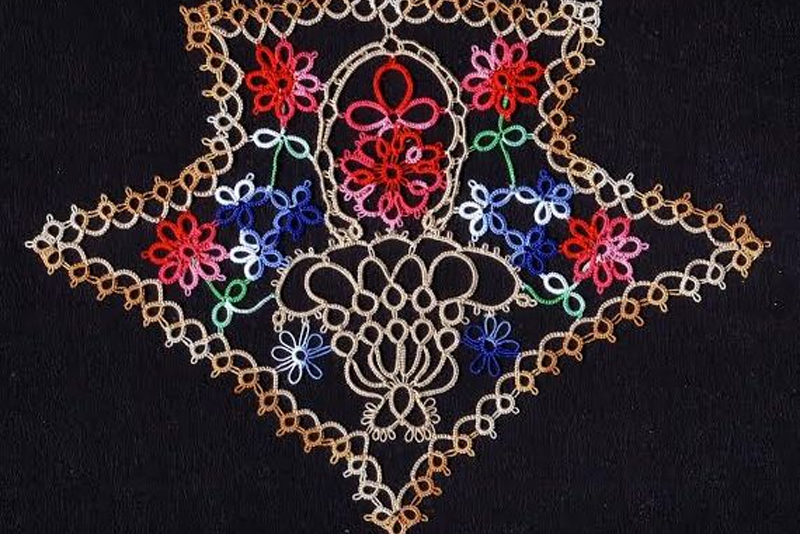
This new book by Annamaria Riccardi is bright with colors and bubbly with enthusiastic designs. This A-4 size paperbound book with 57 pages is published by Prestigio Edizioni SRL, Rome Italy, 2013. It is printed all in Italian.
The designs are presented in a very large format with each design a full color photo covering a whole page. The facing companion pages present the text of the tatting directions in Italian.
The companion pages also present diagrams in black and white with color highlights. The diagrams are shown in a very large size for easy viewing. The double stitch count is given on one diagram while the next segment of the diagram shows the order of working the tatted elements. Most importantly, the starting point of each piece is clearly marked with red arrows. And the direction of the work is indicated with additional arrows. This extra clarification is used to show which side of the work is facing up.
The essential instructions for the new tatter are given in the last seven pages of the book. The full color diagrams are also presented in a very large format for ease of understanding. They need no translation.
Although the traditional up join is taught in that last section, the down join could soon be mastered to enhance the front/back side look to the tatting. And these items will be fun to tat and perfect to share as gifts.
Annamaria's wonderful choice of brilliant color threads make these designs of traditional tatting sparkle! Some familiar tatted edgings will be easily recognizable. But the bright glowing colors and addition of multi-hued beads make them ever fresh. This book would make a delightful present for a new tatter and give the seasoned tatter many hours of tatting pleasure.
You Should Also Read:
Italian - English Tatting Terms
Reading Writing Diagramming

Related Articles
Editor's Picks Articles
Top Ten Articles
Previous Features
Site Map
Content copyright © 2023 by Georgia Seitz. All rights reserved.
This content was written by Georgia Seitz. If you wish to use this content in any manner, you need written permission. Contact Georgia Seitz for details.